
CATEGORIES:
BiologyChemistryConstructionCultureEcologyEconomyElectronicsFinanceGeographyHistoryInformaticsLawMathematicsMechanicsMedicineOtherPedagogyPhilosophyPhysicsPolicyPsychologySociologySportTourism
Green energy in HVAC systems: current state, technologies and prospects
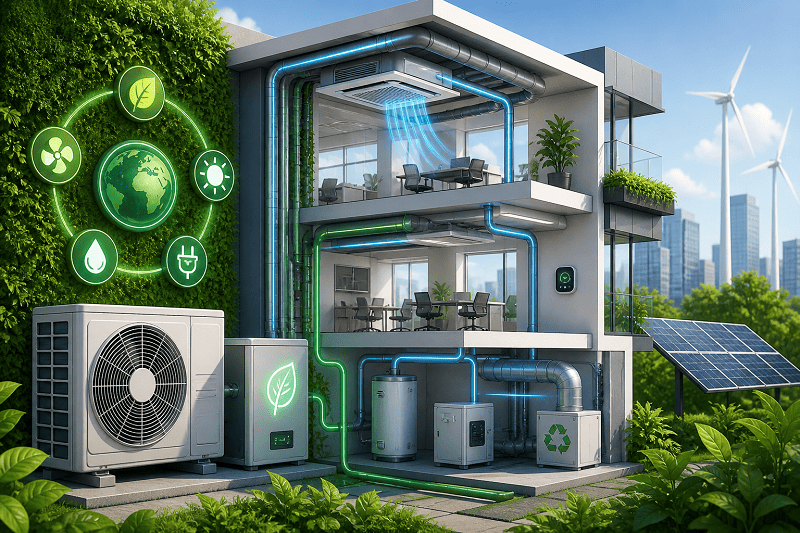
Heating, ventilation and air conditioning systems account for more than 30% of global final energy consumption and about half of the electricity demand in the building sector. By 2050, residential cooling alone could consume 280% more energy if no action is taken. But there is a cleaner path forward. Over the past decade, green energy integration into HVAC has shifted from an experimental niche to a strategic necessity. Solar photovoltaic (PV) assist, solar thermal absorption cooling, geothermal heat pumps and hybrid solutions with energy storage already demonstrate energy savings of 20-55% and measurable cuts in operational carbon. This paper reviews the main technologies, efficiency metrics, economic viability and emerging trends, with reference to current research and market forecasts up to 2032.
1. The urgent case for green HVAC
Buildings are responsible for approximately 30% of global energy consumption and up to 25% of CO2 emissions world-wide. Within that share, HVAC systems are the single largest end-use. The International Energy Agency highlights that space cooling alone already demands hundreds of extra terawatt-hours each year, and without intervention, this demand will accelerate dramatically. Rising ambient temperatures, urbanisation and growing comfort expectations in developing economies create a perfect storm. At the same time, the decarbonisation of heating - often forgotten in favour of electricity generation - remains a massive challenge.
Fossil-fuel boilers and conventional electric resistance heating lock consumers into volatile fuel prices and high emissions. Fortunately, EU data shows that the share of renewables in heating and cooling reached 26.7% in 2024, the highest level since records began in 2004 (11.7%). However, the annual increase of only 0.5 percentage points remains far below what is needed. This gap between ambition and reality is precisely where green HVAC technologies can make the biggest difference.
2. Solar-driven heating and cooling technologies
Solar energy can be harvested for HVAC in two fundamentally different ways: photovoltaic (PV) electricity for compressors and solar thermal energy for thermally driven cooling. Both routes are maturing rapidly, and often they work best together.
Photovoltaic-assisted air conditioning and heat pumps. PV modules convert sunlight directly into electricity, which then powers compressor-based systems. The most immediate advantage is self-consumption. Surplus solar power can be stored in batteries or exported to the grid, while during low solar radiation the system draws grid electricity. Research from China on a solar-augmented air source heat pump (ASHP) showed annual energy-saving efficiency up to 24.13% in the most advanced configuration. The solar-augmented system achieved a highest seasonal energy efficiency ratio of 2.60 and a heating seasonal performance factor of 3.65. Overall, solar integration increased the energy efficiency of optimised building systems by 18% and reduced their carbon content by 37.78%.
For those who prefer concrete numbers: a standalone heat pump with a COP of 3-4 can reach COP values above 5.0 when combined with solar PV and smart controls, dramatically lowering operating costs. Meanwhile, the global market for on-grid PV air conditioners is projected to grow from USD 1.20 billion in 2025 to USD 2.92 billion by 2032 (CAGR of 13.58%). This is not a future promise; it is already happening.
Solar thermal absorption cooling. Absorption chillers use heat - instead of electricity - to drive the cooling cycle. When that heat comes from solar thermal collectors, the system consumes almost no grid power for cooling. Among thermally driven systems, absorption chillers are the most mature, reliable and efficient. A single-effect absorption chiller can achieve a coefficient of performance (COP) of around 0.7-0.8, with cooling capacities of 30 kW or more. In extremely hot climates, solar-driven absorption cooling can save 31.6% of primary energy and 1222 kg CO2 eq annually compared to conventional vapour compression.
The main challenge is economic: without government subsidies, solar absorption cooling cannot yet compete with conventional chillers for most applications, especially at smaller scales. However, for large buildings, district cooling networks and industrial processes, the levelised cost of cooling becomes favourable. The most cost-effective configurations combine solar thermal with backup systems and optimised storage, avoiding oversized and inefficient gas-fired backup designs.
3. Geothermal heat pumps and hybrid systems: efficiency that pays back
Geothermal heat pumps. Geothermal (ground-source) heat pumps (GSHPs) exploit the stable temperature of the earth a few metres below the surface. Unlike air-source units, their performance does not collapse during extreme weather. A typical GSHP offers a COP of 5.0 - meaning 5 kWh of heat for every 1 kWh of electricity consumed - compared to 3.0 for an ASHP and less than 1.1 for a gas boiler. In practice, a properly designed GSHP system can reduce heating and cooling bills by 30-60%.
Upfront cost is the main barrier. Installing a vertical loop system for a single-family home ranges from USD 18,500 to USD 49,000 depending on size and ground conditions. Yet the payback period can be surprisingly short when installation is done right. Real-world examples show payback of 7-8 years with annual savings of nearly USD 4,000. After that, the user enjoys virtually free heating and cooling for decades, as the system lasts more than 25 years and the collection wells can exceed 50 years with proper maintenance. Horizontal loops are cheaper but require more land; vertical loops cost more upfront but guarantee high efficiency and minimal land footprint.
Hybrid systems and energy storage. The most exciting developments are happening at the intersection of multiple renewable sources, smart controls and energy storage. Hybrid HVAC systems combine heat pumps with solar PV, wind turbines, battery storage and sometimes thermal storage in a single integrated unit. The global hybrid HVAC market was valued at USD 16.24 billion in 2024 and is projected to reach USD 25.44 billion by 2032 (CAGR 5.60%).
A stunning example comes from China, where researchers built a hybrid wind-solar heat pump for a residential building in Shenyang. The system integrated 13.12 kW of solar capacity, two wind turbines, 25.5 kWh of battery storage and a phase-change material water tank. With AI-based optimisation, the system reduced household energy costs by 54.7% and grid reliance by 75%. After 10 years of operation, the soil temperature around the ground exchangers dropped by only 0.42°C, preventing long-term thermal imbalance - a common issue in standalone geothermal systems.
Another promising approach is the solar-assisted ejector-compression heat pump. When integrated with photovoltaic/thermal collectors, this system achieved a COP improvement of 38.2% and exergy efficiency gain of 16.9 percentage points compared to a standard air-source heat pump. CO2 emissions fell by 15-29%, while SO2 and NOx emissions also dropped substantially. The message is clear: combining renewables with intelligent control strategies unlocks performance that neither component can achieve alone.
4. Comparative analysis and market outlook
To help readers navigate the technology landscape, Table 1 summarises the main green HVAC technologies with their efficiency metrics and typical applications. Table 2 provides indicative economic data and payback ranges, while Table 3 highlights the projected market growth of key segments.
Table 1 - Efficiency comparison of key green HVAC technologies
| Technology | Typical COP / SEER | Carbon reduction potential | Best application |
|---|---|---|---|
| Standard air-source heat pump (ASHP) | COP 3.0-4.0 | Baseline | Mild climates |
| Solar-assisted ASHP | COP 3.8-5.0 | 20-38% | Mixed climates with good solar |
| Geothermal heat pump (GSHP) | COP 5.0-6.0 | 40-60% | All climates, large lots |
| Solar thermal absorption chiller | COP (thermal) 0.7-0.8 | 30-35% | Hot climates, large buildings |
| Hybrid PV-wind-heat pump + storage | System COP >5.5 | Up to 55% | Net-zero homes, off-grid capable |
Table 2 - Economic indicators (residential, 2025-2026 data)
| Technology | Upfront cost (typical) | Annual operating cost advantage | Payback period |
|---|---|---|---|
| Solar-assisted ASHP (retrofit) | USD 4,000-8,000 extra | 25-35% lower bills | 6-10 years |
| Geothermal (vertical loop) | USD 18,500-49,000 | 40-60% lower | 7-15 years |
| Hybrid PV-wind-HP + storage (new build) | USD 30,000-60,000 | 50-55% lower | 8-12 years |
| Solar thermal absorption chiller (commercial) | USD 150-300 per kW cooling | 30% lower primary energy | 8-14 years (with incentives) |
Note: Payback varies strongly with location, energy prices, and available subsidies. Poorly designed systems can exceed 20 years, while high-quality installations pay back in 7 years.
Table 3 - Projected market growth of green HVAC segments
| Segment | Market value (2025) | Projected value (2032) | CAGR |
|---|---|---|---|
| Hybrid HVAC (global) | USD 17.28 bn | USD 25.44 bn | 5.60% |
| On-grid PV air conditioners | USD 1.20 bn | USD 2.92 bn | 13.58% |
| Energy-efficient buildings (HVAC focus) | USD 117 bn (total) | USD 218 bn (total) | 8.11% |
Sources: Fortune Business Insights, GII Research, Research and Markets
Looking ahead, several trends will shape the next decade. Digitalisation and AI-based control are already enabling real-time optimisation of hybrid systems, as seen in the Chinese wind-solar heat pump. IoT sensors and predictive maintenance reduce operational failures and extend equipment lifespan. At the policy level, government incentives - tax credits, rebates and low-interest loans - remain essential to overcome the upfront cost barrier. The EU directive requires each member state to increase its share of renewables in heating and cooling by at least 0.8 percentage points annually from 2021 to 2025, and 1.1 percentage points from 2026 to 2030. Similar schemes in North America and Asia are accelerating market growth.
What is perhaps most striking is the growing evidence that green HVAC is not only an environmental choice but increasingly a financial one. In regions with high electricity prices and favourable solar conditions, the total cost of ownership of a well-designed solar-assisted or geothermal system is already lower than that of a conventional solution. Companies implementing such systems - for example, Green Top Heating and Cooling - are demonstrating on a daily basis that renewable-powered heating and cooling can be reliable, scalable and cost-effective.
5. Conclusion
Green energy integration into HVAC systems is progressing from niche demonstration to mainstream deployment. Solar PV assistance, solar thermal absorption cooling, geothermal heat pumps and intelligent hybrid solutions with storage each offer significant energy and carbon savings. The efficiency gains are measurable (COP improvements of 20-40%), the emissions reductions are tangible (30-55% lower CO2) and the economic case is improving rapidly. The remaining barriers - high upfront costs, lack of skilled installers and uneven policy support - are not insurmountable. As markets grow and technologies mature, green HVAC will become the default rather than the exception. The numbers leave no room for doubt: the future of heating and cooling is renewable, hybrid and digitally optimised.
References
- IEA (2024). Buildings - Global energy consumption and emissions data. International Energy Agency; cited in Our World in Data, 2026.
- Himmelstein, S. (2025). A solar assist for HVAC efficiency. GlobalSpec Insights; Journal of Building Engineering.
- Al-Shamani, A. et al. (2025-2026). Solar-assisted ejector-compression heat pump: 4E analysis and COP improvement. Energy and Buildings, Volume 354, 116952.
- Zhongkai University / Beijing University of Civil Engineering and Architecture (2025). Solar-augmented ASHP configurations. Journal of Building Engineering.
- Ecoforest (2025). Geothermal Energy Profitability: Economic Analysis and Payback Period. Ecoforest technical report.
- Fortune Business Insights (2025). Hybrid HVAC Market Size, Share & Trends Report 2025-2032.
- Eurostat (2026). Renewable energy in heating and cooling: share reached 26.7% in 2024. News release DDN-20260126-1.
- Interesting Engineering (2025). China's hybrid wind-solar heat pump slashes home energy bills by 55%. IE Energy section.
- GII Research / MarketsandMarkets (2026). On Grid Photovoltaic Air Conditioner Market Forecast 2026-2032.
Date: 2026-03-18; view: 1806
| <== previous page | | | next page ==> |
| Knoxville, Tennessee: The Scruffy City's Hidden Spark | | |