
CATEGORIES:
BiologyChemistryConstructionCultureEcologyEconomyElectronicsFinanceGeographyHistoryInformaticsLawMathematicsMechanicsMedicineOtherPedagogyPhilosophyPhysicsPolicyPsychologySociologySportTourism
Power of the Traffic Officer and Competent Officer
Section 135. For the safety and convenience of the traffic, the traffic officer shall have the power to prescribe any area or location over which the owner of the land has given right of way as a way under this Act.
Section 136. The Director General shall have the power to appoint persons who have the qualification to be prescribed and pass the traffic volunteers training course to perform the duty in assistance to the duty performance of the competent officer.
The qualifications of the trainer, particulars of the traffic volunteers training course and duties of the traffic volunteers as well as their uniform and emblem shall be prescribed by the Director General.
Section 137. In performing his duty assigned to him under this Act. a traffic volunteer shall be an officer under the Criminal Code.
Section 138. In the event of an emergency or accident that causes the traffic in any area to be unsafe or inconvenient. The traffic officer or competent officer shall have the power to execute any action deemed appropriate or necessary in connection with the traffic in such area in order to bring about the safety and convenience in the traffic as follows
(1) to prohibit the entrance of vehicles of all or certain categories or pedestrians in any way or any part of any way:
(2) to prohibit the stopping or parking of vehicles in any way or any part of any way;
(3) to prohibit the turning, turning around or backing of vehicles in any way or any part of any way;
(4) to prescribe any way or any part of any way for a one-way traffic.
However, for a period deemed necessary.
Section 139. In any or any part of any way deemed suitable that with a notification of certain traffic rules and regulations it is sure to bring about the safety and convenience in the traffic, the traffic officer shall have the power to notify the rules and regulations as follows:
(1) to prohibit the use of vehicles of every or certain categories
(2) to prohibit the stopping or parking
(3) to prohibit the turning, turning around or backing of vehicles
(4) to prescribe a one-way traffic
(5) to prescribe time periods for vehicle parking in narrow ways or at critical places
(6) to prescribe speed limits within the rates prescribed in the Ministerial Regulations
(7) to prescribe traffic lanes or channels for up and down traffic
(8) to prescribe principal and secondary roadways
(9) to prescribe vehicle parking of vehicle parking lots
(10) to prescribe rules for the use of ways or traffic lanes for vehicles of certain categories
(11) to prescribe rules for the use of school buses
(12) to prescribe rules fro the conveyance of passengers on bicycles
(13) to control processions or public gatherings
(14) to control or prohibit the turning of vehicles at junctions
(15) to draw lines or make traffic marks on the surface of ways or install traffic signals or traffic signs
(16) to prescribe the distance at any part of the way that a vehicle may go beyond the middle line of the way made by the traffic officer
(17) to prescribe rules for the parking of damaged or ruined vehicles including a vehicle being repaired in the way
(18) to prescribe rules for the road crossing of pedestrians at a place where no pedestrians crossing exists
(19) to prescribe the use of vehicle lamps
(20) to prescribe the use of sound signals
(21) to prescribe rules for the permission and the use of vehicles with wheels or part of wheels touching the road surface being of non-rubber.
Section 140. Upon finding a vehicle driver violating or not complying with the provisions of the Act or the law on such vehicle, the traffic officer or competent officer may give a verbal warning to such driver or issue a written order to the driver to report at a police station or the office of the traffic officer, except an offence liable to the penalty pursuant to Section 160 that verbal warning shall not be applied. In the event of the driver is nowhere to be found. a written order shall be left on the vehicle at a conspicuous place
In issuing a written order to a drive to report to a police station or the office of the traffic officer or the competent official, the traffic officer or the competent officer may temporarily seize the driving license by issuing a driving license replacement, but the competent official must deliver such driving license to the officer pursuant to Section 145 within eight hours from the time of the issue of the written order.
A driving license replacement issued pursuant to paragraph two shall be valid for use in lieu of the driving license for a period not exceeding seven days. After the competent officer pursuant to paragraph two having given a verbal warning to or having imposed a fine on the drive and the fine having been duly paid, he shall immediately return the driving license to the driver, except in the case for the procedure for the seizure of such pursuant to Section 161 when the traffic officer or competent officer is required to issue a driving license replacement for use in lieu of the driving license for a period not exceeding fifteen days.
The written order and the driving license replacement shall be in accordance with the forms prescribed by the traffic officer.
Section 141. A driver who is given a written order pursuant to Section 140 shall comply in the following cases:
(1) To pay a fine pursuant number notified in 2 written order or under number notified by Traffic officer or Competent Officer at location fixed by Director General in Government Gazette.
(2) To pay a fine pursuant number notified in written order by sending money-order or bank check with copy of written order to Director General.
In case of the Traffic Officer or the Competent Officer has taken driver’s license, the Traffic Officer shall give driver’s license to drive who has received a written order immediately.
Section 141 bis. In case of driver or vehicle owner who has received a written order but he does not comply with Section 141. The examining officer has a power following.
Section 142.
Section 143. If it appears that a driver has taken a vehicle in poor condition under Section 6 to use on the roadways, he shall be punished under that provision and the traffic officer or the competent officer is empowered to issue a written order to him to repair his vehicle.
Section 143 bis. If it appears that a driver is using in a way a vehicle whose condition is not correct according to Section 5. Besides the driver being liable to penalty under such provisions the traffic officer or competent officer shall have the power to order him or the owner to have the vehicle put right.
Section 144. After the owner or driver having repaired or modified the vehicle in accordance with the order of the traffic officer or competent office pursuant to Section 143 such vehicle shall be brought to the traffic officer or the person appointed by the Director General for inspection and certification, and the owner or driver shall put the vehicle to use in a way only after having obtained the said certificate.
The inspection and certification pursuant to paragraph one shall be in accordance with the prescriptions in Ministerial Regulations.
Section 145. The Investigation Officer shall have the power to investigate all the offences under this Act in accordance with the law on criminal procedures except the offences under Section 160 paragraph two and shall have the power to impose fines or give verbal warnings
Section 146. The fine payments under this Act obtained in Bangkok Metropolis or any Changwat or any locality specified in the Notification of the Ministry of Interior shall be given in part to the Bangkok Metropolis or the Municipality of such Changwat for traffic management or wholly allocated to the locality specified in the Notification of the Ministry of Interior.
Penalty Provisions
Section 147. Any person who violates or does not comply with Section 12. Section 79, Section 80. Section 82, Section 103, Section 104, Section 105, Section 106, Section 115, Section 116, Section 117, Section 131 or Section 132 is liable to a fine of not exceeding two hundred Baht.
Section 148. Any person who violates or does not comply with Section 6 paragraph one or paragraph two, Section 8 paragraph one, Section 9, Section 10, Section 11, Section 14, paragraph one, Section 20, Section 36, Section 37, Section 38, Section 41, Section 42, Section 44, Section 51, Section 54, Section 55,paragraph one, Section 57, Section 58, Section 60, Section 62, Section 63, Section 68, Section 69, Section 70, Section 71, Section 73 paragraph two, Section 74, Section 76, Section 83 Section 84, Section 87, Section 88, Section 96 paragraph one, Section 97, Section 100 Section 107, Section 108, Section 109, Section 110, Section 111, Section 112, Section 114, paragraph one. Section 118, Section 119, Section 120, Section 121, Section 122, Section 123, Section 124, Section 126, Section 129 or Section 133 is liable to a fine of not exceeding five hundred Baht.
Section 149. Any person who does not comply with Section 98 paragraph two or paragraph three is liable to a fine of not exceeding five hundred Baht.
Section 150. Any person
(1) who does not comply with the rules or notification prescribed by the Director General pursuant to Section 8 paragraph two or Section 14 paragraph two
(2) who does not comply with the conditions prescribed by the Director General pursuant to Section 13 paragraph two
(3) who does not comply with the Ministerial Regulation issued under Section 18
(4) who violates the order of the traffic officer given under Section 113
(5) who violates the order of the traffic officer or competent officer given under Section 140 paragraph two is liable to a fine of not exceeding five hundred Baht.
Section 151. Any person who violates or does not comply with Section 7. Section 13 paragraph one , Section 15 paragraph one, Section 16, Section 21 paragraph one. Section 22, Section 23 <1>, Section 24, Section 25, Section 26, Section 29, Section 49, Section 50, Section 56, Section 64, Section 67 paragraph one, Section 73 paragraph one or three, Section 77 paragraph one, Section 85, Section 86, Section 89 paragraph one, Section 90, Section 91, Section 92, Section 93, Section 94 paragraph one, Section 95, Section 99, Section 127, Section 128, Section 130 or Section 134 or does not comply with the notification prescribed by the Director –General pursuant to Section 15 paragraph two or does not comply with the Ministerial Regulation issued under Section 77 paragraph two or Section 96 paragraph two is liable to a fine of not exceeding one thousand bath.
Section 152.
Section 153. Any person who engages in taking employment to convey passengers by a taxi and does not park his vehicle at the place prescribed by a royal decree issued under Section 102 is liable to a fine of not exceeding one thousand Baht.
Section 154. Whoever:
(1) violates the orders of the officers as prescribed in the section 138 paragraph one or the Section 142 paragraph one
(2) violates the orders, rules or the regulations of the traffic officers as prescribed in the Section 139
(3) violates the orders of the officers as prescribed in the Section 142 paragraph two or
(4) violates the orders of the officers as prescribed in the Section 143 bis
If not otherwise stated as an offence in this Act, the offenders may be fined one thousand Baht for one time
(5) Any person who does not comply will Section 141 without adequate cause is liable to a fine of not exceeding one thousand Baht.
(6) Any person who brings a vehicle ordered by the traffic officer or competent officer to be repaired or modified by the owner or driver pursuant to Section 143 to use in a way without the certificate pursuant to Section 144 is liable to a fine of not exceeding one thousand Baht or to a fine on a daily basis at the rate of fifty Baht per day until correct compliance is effected.
(7) Any person who violates or does not comply with Section 35, Section 43, Section 45, Section 46, Section 47, Section 48, Section 53, Section 65 paragraph one or Section 125 is liable to a fine from four hundred to one thousand Baht.
Section 157. bis. Any driver who violates or does not perform as the officers ordered under Section 43 bis or Section 43 ter must be punished not exceeding one thousand Baht.
Any driver who violates the Section 43 bis paragraph one the violator shall be liable to punishment more than the punishment in the law on narcotic for one third and the court shall order to suspend the license for not less than six month or revoke the license.
If the offence prescribed in the Section 43 bis may cause the grievous harm to the other person the offender shall be liable to imprisonment for a term from two years to six years and further a fine from forty thousand Baht to one hundred and twenty thousand Baht and the court shall revoke the license. If the offense causes the other person to be die, the offender shall be liable to imprisonment for a tern from three years to ten years and a fine from sixty thousand Baht to two hundred and twenty thousand Baht and the court shall revoke the license.
(8) Any person who violates or does not comply with Section 17 paragraph one, Section 28 or Section 100 paragraph one or paragraph two, or does not comply with the ministerial Regulation issued under Section 17 paragraph two is liable to an imprisonment for not exceeding one month or to a fine of not exceeding two thousand Baht or to both.
(9) Any person who violates and order of the traffic officer or competent officer given under Section 59 paragraph one is liable to an imprisonment for a period not exceeding one month or to a fine of not exceeding two thousand Baht or to both.
(10) Any person who does not comply with Section 78 is liable to an imprisonment for a period not exceeding one month or to a fine of not exceeding two thousand Baht or to both.
If non compliance with Section 78 is a cause of a serious injury or death. Such responsible person is liable to an imprisonment for a period not exceeding three months or to a fine of not exceeding five thousand Baht or to both.
Section 160 bis : Anyone, who violates Section 134, shall be punished by being taken into prison not less time than three months or is liable to fine not exceeding ten thousand Baht or both fine and prison, and the court shall or both fine and prison, and the court shall forbid to use the license not less time than one month or revoke the license.
(11) In the event of a driver having committed an offence under this Act, the Commander of the Bangkok Metropolitan Police, the Commander of the Provincial Police, the Commander of the Traffic Police, the Commander of the Highways Police or the person authorized by the said officers shall have the power to seize and hold the driving license of such driver for not exceeding sixty days at a time.
The driver whose driving license is seized pursuant to paragraph one may appeal to the Director General within fifteen days from the day of the seizure of the driving license.
The Director General shall consider the petition and give the decision to either seize or not seize the driving license within one month from the day of receipt of the appeal. Such decision of the Director General shall be final.
(12) In a lawsuit that a driver is convicted by the final judgment of the Court for the commission of an offence under this Act or the law governing such vehicle, besides the penalty that such driver is liable under such provision but, if it appears to the Court that the driver is likely to cause danger to persons or property of other persons if allowed to drive, the Court shall have the power to order the suspension or revocation of the driving license of such person.
(13) With regard to a lawsuit that there is a commission of an act that violates or does not comply with the provision of the Act or the law governing such a vehicle. if such violation or non –compliance has caused damage to the traffic signals or traffic sings installed by the competent officer, the Public Prosecution Officer, upon prosecuting the offender, shall demand for compensation for the damage inflicted upon the said traffic signals or traffic signs.
Regulatory signs

| Give way |
| You must proceed with care and give way to vehicles and pedestrians crossing ahead. Only when you see that the way is safe and clear of traffic on the crossroads should you proceed with caution. |

| Priority to vehicles from the opposite direction |
| You must stop at the sign to let the vehicles coming from the opposite direction pass first. If there are vehicles stopped in front, you must stop behind the sign. Only when the vehicle s coming from the opposite direction has passed can you proceed. |

| No entry |
| No vehicles are allowed to enter the restricted zone |

| Stop sign |
| You must bring your vehicle to all halt. Only when you see that the way is clear and safe should you proceed with caution. |

| No right turn or U-turn |
| Do not turn right or make a U-turn |

| No passing |
| Do not overtake other vehicles within this restricted zone |

| No right turn |
| Right turned are prohibited |

| No left turn |
| Left turns are prohibited |

| No change of lanes to the left |
| Do not change lanes to the left |

| No change of lanes to the right |
| Do not change lanes to the right |

| No U-Turn |
| U-Turns are prohibited in all cases |

| no left U-turn |
| Do not make a left U-turn for any reason in the restricted zone. |

| Cars prohibited |
| Cars are prohibited from entering the restricted zone. |

| Motorcycles prohibited |
| Motorcycles are prohibited from entering the restricted zone. |

| Motor-tricycles prohibited |
| Motor-tricycles are prohibited from entering the restricted zone |

| Trucks prohibited |
| Truck are prohibited from entering the restricted zone |

| Bicycles prohibited |
| Bicycles are prohibited from entering the restricted zone. |

| Tricycles prohibited |
| Tricycles are prohibited from entering the restricted zone. |

| Tractors prohibited |
| Tractors are prohibited from entering the restricted zone |

| Cart prohibited |
| Carts are prohibited from entering the restricted zone. |

| Trailers prohibited |
| Trailers or semi-trailers are prohibited from entering the restricted zone. |

| Motor-tricycles and motorcycles prohibited |
| Motor-tricycles and motorcycles are prohibited from entering the restricted zone |

| No horn |
| Do not use horns or make any disturbing noises within this restricted zone |

| No pedestrians |
| Pedestrians are prohibited from entering the restricted zone |

| No parking |
| All vehicles are prohibited from parking along the kerb, except temporarily for picking up/alighting or loading/unloading, which must be done without delay. |

| No standing and parking |
| All vehicles are strictly prohibited from standing or parking along the kerb. |

| Stop check |
| You must stop at the sign to allow inspection by the authorities. You may proceed when permitted by the authorities. |

| Speed limit |
| Do not exceed the speed limit, which is indicated in kilometers per hour, until you are out of the speed limit zone. |

| Weight limit |
| All vehicles, laden or unladen, exceeding the limit, indicated in tons, are prohibited from entering the restricted zone. |

| Width Limit |
| All vehicles that are wider than the limit, indicated in meters, are prohibited from entering the restricted zone. |

| Height Limit |
| All vehicles, laden or unladen, exceeding the limit, indicated in meters, are prohibited from entering the restricted zones. |

| Ahead only |
| Follow the directions by driving straight ahead |

| Keep right |
| Keep to the right of the sign |

| Keep left |
| Keep to the left of the sign |

| Turn right |
| Follow the directions by turning right |

| Turn left |
| Follow the directions by turning left |

| Turn left |
| Turn left only |

| Turn right |
| Turn right only |

| Left turn or right turn |
| You must turn either left or right |

| Bear left or right |
| You must proceed either to the left or right of the sign. |

| Roundabout |
| All vehicles must go clockwise round the roundabout. Vehicle entering the roundabout must give way to and let vehicle already on the roundabout pass first. Do not cut in front of vehicles driving on the roundabout. |

| End of restriction |
| The restricted zones indicated by previous signs have ended |
Warning Road Signs

| Left curve ahead |
| The road bears to the left. You should slow down accordingly, keep to the left, and drive with caution. |

| Right curve ahead |
| The road bears to the right. You should slow down accordingly, keep to the left, and drive with caution. |

| Left turn ahead |
| The road bends sharply to the left. You should slow down accordingly, keep to the left, and drive with caution. |

| Right turn ahead |
| The road bends sharply to the right. You should slow down accordingly, keep to the left, and drive with caution. |

| Left reverse curve ahead |
| The road curves to the left and then straightens. You should slow down accordingly, keep to the left, and drive with caution. |

| Right reverse curve ahead |
| The road curves to the right and then straightens. You should slow down accordingly, keep to the left, and drive with caution. |

| Left reverse turn |
| The road bends sharply to the left and then straightens. You should slow down accordingly, keep to the left, and drive with caution. |

| Right reverse turn |
| The road bends sharply to the right and then straightens. You should slow down accordingly, keep to the left, and drive with caution. |

| Left winding road |
| The road zigzags on the left. You should slow down accordingly, keep to the left, and drive with caution. |

| Right winding road ahead |
| The road zigzags on the right. You should slow down accordingly, keep to the left, and drive with caution. |

| Roundabout ahead |
| The road ahead goes round in a circle. You should slow down and proceed on to the roundabout traffic with caution. |

| Crossroads ahead |
| The roads intersect as indicated on the sign, which may show the priority road as larger than secondary road. You should slow down and proceed with caution. |

| Junction ahead on the right ahead |
| The road ahead intersects with a secondary road on the right. You should proceed with caution. |

| Junction ahead on the left ahead |
| The road ahead intersects with a secondary road on the right. You should proceed with caution. | |

| Junction ahead on the left and then the right |
| The road ahead intersects with a secondary road on the left followed by another on the right. You should proceed with caution. |

| Junction ahead on the right and then the left |
| The road ahead intersects with a secondary road on the right followed by another on the left. You should proceed with a caution |

| Merging road on the left |
| The road ahead connects with a secondary road on the left. You should proceed with caution |

| Merging road on the right |
| The road ahead connects with a secondary road on the right. You should proceed with caution. |

| Railway crossing with gate ahead | ||
| The road ahead crosses a railway which has a fence or barrier. On seeing this sign, you must slow down and be ready to stop when you hear the signal or the barrier descends manually or mechanically. If there are other vehicles stopping ahead of you, you must stop behind. Only when the barrier opens can the waiting vehicles move forward one after the other. | |||

| Railway crossing without gate ahead | ||
| The road ahead crosses a railway which has no barrier. You must slow down significantly and watch out for trains to the right and left. If a train is approaching, you must stop at least 5 meters from the train and wait until it has passed and it is safe to proceed. Do not ever cut across the track in front of a train. | |||

| Signal ahead | ||
| The road ahead has traffic lights. You should slow down and be ready to follow the signals. | |||

| Pedestrian crossing ahead |
| The road ahead has a pedestrian crossing or a village at the road sides with pedestrians crossing constantly. You should slow down to a safe speed and beware of pedestrians. If there are pedestrians wishing to cross, you must stop and let them cross safely. |

| Road narrow on the left |
| The road ahead narrows on the left. You should slow down and proceed with more caution. |

| Road narrow on the right |
| The road ahead narrows on the right. You should slow down and proceed with more caution. |

| Slippery road ahead |
| The road ahead is slippery. When wet, accidents are likely to occur. You should slow down and beware of skidding. Do not brake heavily and sharply. Stopping, slowing down or turning on a slippery road must be done with extra caution. |

| Loose surface | |
| The road surface may throw up stones if you drive at high speed. You should slow down and be aware of the danger from loose surfaces. | ||

| Opening bridge ahead | |
| The road passes over a bridge that opens to let ships pass under. You should slow down and watch out for when the way is blocked by the bridge opening, so as not to cause danger to both the preceding and following vehicles. |

| Narrow bridge ahead |
| The road ahead goes over a narrow bridge on which vehicles can barely pass. You should slow down and proceed with caution keeping aware of the possible danger from vehicles coming in the opposite direction. You must obey any other road signs that may be evident. |

| Sharp rise ahead |
| The road ahead changes elevation abruptly. e.g. at a bridge, sewage crossing or speed bump. Etc. You should slow down and proceed with caution. |

| Uneven road ahead |
| The road ahead is very bumpy with potholes or has ridges. You should slow down and take extra caution. |

| Steep hill ascent ahead |
| The road goes steeply uphill as indicated by the percentage of elevation. Your view of passing vehicles may be obstructed. You should slow down, keep as close to the left as possible and watch out for vehicles passing in the opposite direction. |

| Steep hill decent ahead |
| The road goes steeply downhill as indicated by the percentage of elevation. You should slow down and keep as close to the left as possible. You should under no circumstances disengage the gears or switch off the engine. As a safety measure, you should stay in a low gear when going down a steep hill. |

| Dual carriage way ends ahead |
| The road ahead merges into two way traffic without a center line. You should slow down, keep to the left and take extra caution. |

| Dual carriage way ahead |
| The road ahead split into one-way traffic parallel roads with a center line. You must keep to the left with caution. |

| Two-way traffic |
| The road is a two-way. You should slow down, keep close to the left and be cautions of danger from vehicles coming in the opposite direction. |

| Double arrow ahead |
| The road changes directions as indicated. You must slow down and proceed with caution. |

| Merging traffic ahead | 
|
| Road merge either from the left or right, as indicated by the signs. You should slow down and proceed with caution. |

| School crossing ahead |
| The road ahead has a school at the side of the road. You should slow down and be aware of possible accident that may occur to schoolchildren. If school children are wishing to cross the street, you must stop your vehicle and let them cross safely. During school hours, you should refrain from using your horn or making other disturbing noises. |

| Animal crossing |
| The road ahead may have cattle crossing. You should slow down and take extra caution. |

| Traffic lane closed on the left |
| The traffic lane ahead on the left is closed. You must change lanes or use the other lanes with caution. |

| Traffic lane closed on the right |
| The traffic lane ahead on the right is closed. You must change lanes or use the other lanes with caution. |
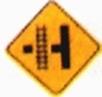
| Railway crossing with gate ahead |
| The road ahead crosses a railway which has a fence or barrier. On seeing this sign, you must slow down and be ready to stop when you hear the signal or the barrier descends manually or mechanically. If there are other vehicles stopping ahead of you, you must stop behind. Only when the barrier opens can the waiting vehicles move forward one after the other. |

| Narrow road ahead |
| The road ahead narrows to the width indicated in meters. Vehicle not wider than the number of meters indicated on the sign can pass, but must slow down and proceed with extra caution. You must obey any other road signs that may be evident. |

| Low clearance ahead |
| The road has low overhead clearance as indicated in meters. Tall vehicles, including their loads, not higher than the number of meters indicated can pass, but must slow down and proceed with extra caution. You must obey any other road signs that may be evident. |

| Dip in road ahead |
| The road ahead changes levels suddenly. You should slow down and take extra care. |

| Falling rocks ahead |
| The road ahead may have fallen rocks on the surface, impending traffic. You should slow down and proceed with extra care. |

| Changing lane to the left ahead |
| You must change lanes as indicated in the sign. You should slow down and proceed with extra care. |

| Changing lane to the right ahead |
| You must change lanes as indicated in the sign. You should slow down and proceed with extra care. |

| Exit to frontage road ahead |
| The main road ahead has an exit to the frontage road. Motorist on the main road wishing to exit to the frontage road should be prepared to exit and motorists on the frontage road should beware of vehicles joining in the same direction. |

| Entrance onto main road |
| The frontage road ahead has an opening onto the main road. Motorists on the frontage road wishing to join the main road should be prepared to enter and motorist on the main road should beware of vehicles joining in the same direction. |

| Right U-turn ahead |
| The road ahead has a right U-turn opening |
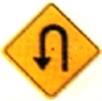
| Left U turn ahead |
| The road ahead has a left U-turn opening |

| Give way ahead |
| The road ahead has a give way sign. You must be ready to give way as soon as you come to the give way sign. You should slow down and proceed with caution. |
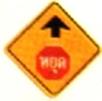
| Stop ahead |
| The road ahead has a stop sign. You should be ready to stop your vehicle immediately at the stop sign. |

| Low flying planes |
| The road ahead approaches an airport. There may be low-flying aircrafts taking off and landing. You should slow down. Upon seeing and aero plane taking off or landing ahead of you, you must stop and let the aero plane pass overhead safely. |
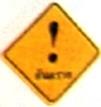
| Danger |
| The road ahead may be dangerous, e.g. an accident risk, a sudden drop in level, etc. You should drive very slowly and proceed with extra caution. |
| Direction to be followed | |
 
    The road is changing directions as indicated. You must slow down and proceed with caution.
|
Road Surface Signs

| No overtaking division line |
| The division line for a two-way traffic road is made of a white. 15- cm- wide painted solid line. You must keep to the left of the division line. Do not cross or stray over it. |

| No overtaking double division lines |
| The double division lines for a two-way traffic road are made of two parallel white, 10-cm-wides, solid, painted lines at a distance of 15 cms apart. Do not cross or stray over the lines when traveling in either direction |

| Stop line |
| A white, 40-cm-wide, solid, painted, transverse line. You must stop every time on reaching the transverse line and check that the way ahead is clear. Only when the way is clear and safe should you cross the transverse line. |

| Give way line |
| A white, dotted, transverse, painted line of 40 cm wide and 60 cm long at spaces of 30 cms apart. You must slow down and check for other vehicles and pedestrians ahead of you, which you must let pass first. Only when you see that the way is clear and safe should you proceed with caution. |
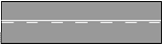
| Double division lines |
| The double division lines for a two-way traffic road are made of a white. 10-cm-wide painted solid line parallel with another white, 10-cm-wide and 200-cm-long dotted line at a space of 200 cms apart. The two lines are 15 cms apart. When you drive with the solid line on you right, you must not cross or stray over it. Vehicles driving with dotted line on their right may cross over the lines with caution. |

| Parking prohibited except temporary loading and unloading | ||
| All vehicles are prohibited from parking, except for temporary loading/unloading, which must be done without delay, along the indicated line which is painted alternately in white |
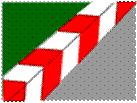
| No parking or no standing | ||
| All vehicles are prohibited from parking or standing along the indicated line which is painted alternately in white and red 50cm-long segments on the kerb, at a roundabout or in other places. |

| No stopping grid area |
| Yellow, 15 cm-wide, solid lines painted diagonally at the angles of 45* and at spaces of 200 cms apart, framed by a yellow, 20 cm-wide-, solid line. All vehicles are prohibited from stopping within the no stopping grid, except for vehicles waiting to turn right at the intersection. |

| Straight and left turn arrow marking, straight and right-turn arrow marking |
| A white solid double-pointed arrow, either pointing straight ahead and to the left or pointing straight ahead and to the right. Motorists driving in this lane must either go straight on or turn left, or go straight on or turn right, accordingly. |

| Straight arrow marking |
| A white arrow pointing straight ahead. Motorists driving in this lane must go straight ahead and are prohibited from turning left or right. |

| Left-turn and right-turn arrow marking |
| A white, solid, double-pointed arrow pointing both to the left and right. Motorists driving in this lane must turn left or right and are prohibited from going straight on. |

| Right-turn arrow marking |
| A white solid arrow pointing to the right. Motorists in this lane must turn right and are prohibited from going straight on or turning left. |

| Left-turn arrow marking |
| A white solid arrow pointing to the left. Motorists driving in this lane must turn left and are prohibited from going straight on or turning right. |

| Pedestrian crossing line |
| White, solid, 75-cm-wide, at least 250-cm-long lines, painted parallel to the road at spaces of 50 cms apart, with either a stop line or a yielding line at least 50 cms before the pedestrian crossing. You should slow down and be ready to stop in time when there are pedestrians crossing the street at a pedestrian crossing. In an area where there are neither traffic officers nor signals, pedestrians have the right of way. Hence, when there is a pedestrian walking on the crossing, you must stop before the stop line or give way line. Only when the pedestrian has crossed safely should you proceed. |
Construction Signs

| Survey crew |
| The road ahead has survey work on or close to the traffic surface or the traffic lanes. You should slow down and take extra care. |

| Men working |
| The road ahead has road works and may be blocked by construction materials or there may be workers on or close to the traffic surface or the traffic lanes. You should slow down and watch out for workers at work and the construction materials. |

| Temporary route on the left |
| The road ahead has road works or construction. You must use the diversion or temporary road on the left. You must slow down and take extra care. |

| Temporary route on the right |
| The road ahead has road works or construction. You must use the diversion or temporary road on the right. You must slow down and take extra care. |
 
| Direction to be followed |
| The areas with the posted signs have traffic diverted as indicated. You should slow down and proceed with extra caution. |

| Road machinery ahead |
| The road ahead has machinery in operation on or close to the traffic surface or the traffic lanes. You should slow down and take extra care. |
| Diversions |


 The road ahead is undergoing repair. Traffic is being diverted temporarily as indicated on the signs.
You should slow down and proceed with extra caution.
The road ahead is undergoing repair. Traffic is being diverted temporarily as indicated on the signs.
You should slow down and proceed with extra caution.
|
1. Which car is legally allowed to go first?
 Answer: Due to car ў. is running on the main road, so it is legally allowed to go first.2. If you are a car”§” and want to go straight, What do you have to do?
  Answer:In case, main roads cross each other, Car § has to stop and allow the car on your left go first (car Ў.) 3. What does car Ў have to do?
  Answer: Stop and let car ў passes the intersection, then process carefully. In case, there is no car ў, you can pass through the intersection legally because you are on the main road4. What does car “Ў” have to do?
  Answer: Wait until two cars ahead move then process carefully5. Which car is legally allowed to go first?
  Answer: Car ў as the main roads cross each other, the car on your left is allowed to go first.6. What does car Ў has to do?
  Answer: Stop and let car ў and ¤ pass first then process carefully because car Ў is running on the secondary road. 7. Does car Ў stop correctly?
 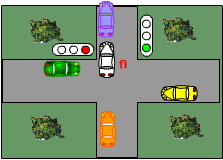 Answer: No, because this area is prohibited for any stop as it obstructs the traffic.8. What does the road mark mean?
  Answer: Car on the left is completely not allowed to pass or overtake the solid line, but the car on the right is allowed to do.9. Which car is legally allowed to go first?
  Answer: Car Ў, because it is running on the main road. Car ў is on the secondary road as there is broken white line shown. 10. What does car Ў. has to do?
  Answer: Stop behind the line and let car in front goes first. If there is no car in front you can carefully pass through.11. What can you do?
  Answer: 1. overtake or pass the line 2. Turn right 3. U-turn12. Does car on the left process correctly?
  Answer: No, the traffic lane that the left car’s taken only allows car to go straight not turn right. 13. Does the car stop correctly?
  Answer: No, because this area is prohibited for stop and parking.14. Which area do you have to stop?
  Answer: Area 1, the area 2 between the solid white lines is for pedestrians15. What does car ў has to do?
 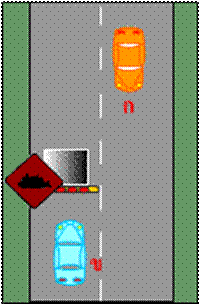 Answer: Signal to the right and stop and let car Ў passes first 16. Is it the correct turning?
  Answer: No, because cars are turning in front of the blue (right) car while pedestrians are also crossing the road. 17. Does the yellow (the back) car process correctly?
  Answer: No, the solid line does not allow any cars for passing/over taking.18. What does car Ў have to do if it is going to turn to the right?
  Answer: Stop and let car ў passes first then turn right19. If you want to take road X, Which traffic lane do you have to take 1 or 2?
  Answer: You can take both lane 1 and lane 2. 20. The B car is going to join one way road, after he turns right which traffic lane does he have to take, 1 or 2 ?
 Date: 2016-01-03; view: 963
| <== previous page | | | next page ==> |
| Animals and Articles in Ways | | | II. The Chapel - Vocabulary |